


Doug Davis
Doug Davis founded Tumbl Trak in 1988 with a simple belief: the right equipment helps people learn to move with confidence.
As a young coach in the late 1960s, Doug watched athletes struggle on dense, unforgiving surfaces while coaches relied on constant physical spotting to guide them through every skill. He knew there had to be a better way.
During summers at Porter Gymnastics Camp, Doug learned from mentors like Leonard Isaacs and Bob Bradley who were pioneering a new approach — using progressions and station-based training so athletes could build skills step by step, on their own terms. But this method required equipment that didn’t yet exist: surfaces that were soft enough to allow for safe repetition, forgiving enough to build confidence, and responsive enough to provide meaningful feedback.
Doug spent years experimenting — tying springboards together, attaching vault springs to plywood, lining up makeshift platforms — before inventing the original Tumbl Trak in the 1980s. What began as a revolution in athletic training proves equally powerful in therapy clinics, schools, and homes, where children with neurological, orthopedic, and sensory differences benefit from the same principle Doug built into every product: when the surface supports you, you’re free to discover what your body can do.
Tumbl Trak®
What if the surface itself could be the teacher?
This question drove Doug Davis through years of experimentation. Traditional training relied on coaches physically guiding athletes through movements — a model that limited how many children could practice at once and kept learners dependent on hands-on assistance. Doug imagined something different: equipment so well-designed that it could support skill development on its own.
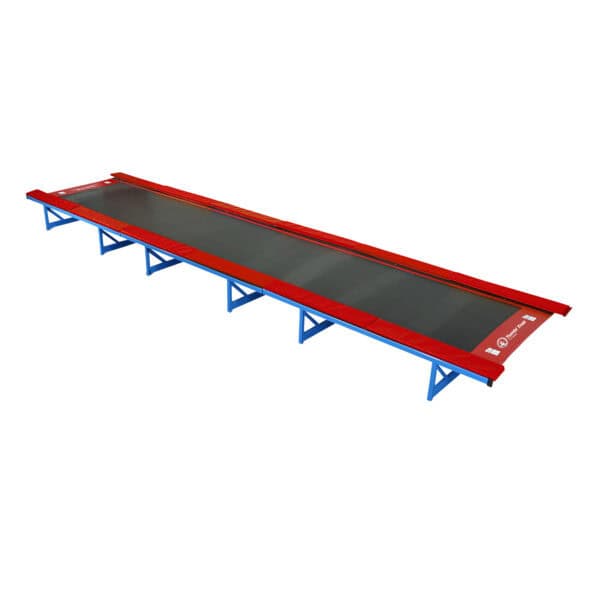
The Tumbl Trak was his answer. Its responsive trampoline bed — five feet wide and available in lengths up to sixty feet — provides just enough give to cushion landings while offering just enough resistance to build strength and control. Children feel the surface respond to their movements, learning to adjust their bodies through direct feedback rather than verbal instruction alone.
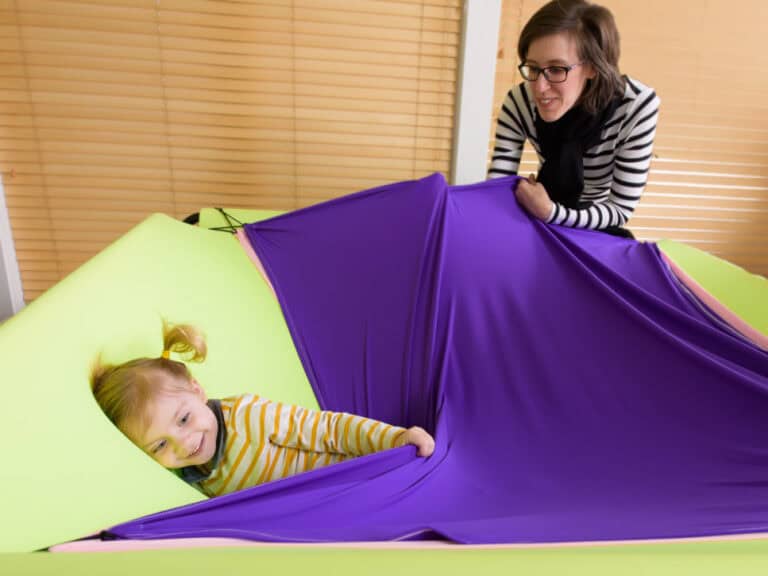
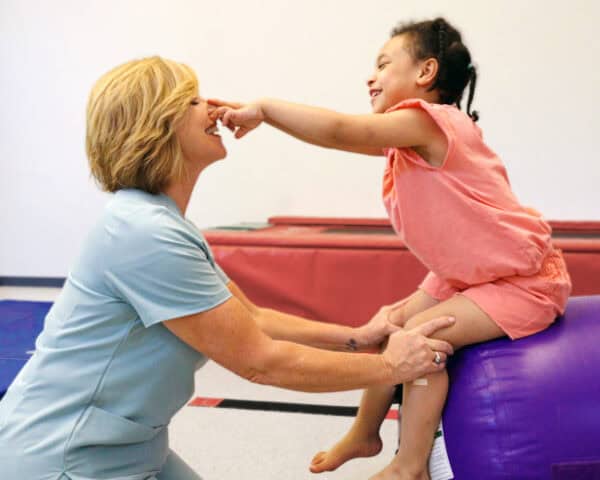
What Doug couldn’t have predicted was how perfectly this design would serve children in therapeutic settings. The same responsive surface that builds athletic skills also provides rich vestibular and proprioceptive input — the deep sensory feedback that helps children with sensory processing differences feel grounded in their bodies. Occupational and physical therapists now use the Tumbl Trak for gait training, balance work, coordination exercises, and sensory integration.
For children who are sensory seeking, the Tumbl Trak offers satisfying, whole-body input. For those who are sensory avoiding, its predictable response builds trust. And for every child working on jumping, walking, or simply finding joy in movement, it remains exactly what Doug intended: a place where the equipment does the teaching, and confidence grows with every bounce.